Tuesday, January 8, 2008

Fried Chicken

Simple and Easy
Southern
Fried Chicken Recipe
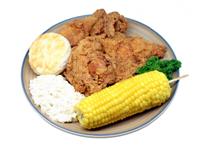
Fried Chicken Dinner

That's as Simple as 1, 2 3

Yes you can create fried chicken with this easy 3 step fried chicken recipe. It's as simple as counting 1, 2, 3.

This chicken recipe is well suiting for someone who has never fried chicken before, someone who is looking to have an immediate impact. Practice, practice, practice and more practice is key to cooking perfection.


Before we get into the actually chicken recipe, here are the secret tips to creating the best tasting fried chicken.

  • Use a black cast iron or heavy bottom skillet to do your frying
  • Use young fresh broiler-fryer whole chicken
  • Create the best flavored chicken by combining 3 simple ingredients (salt, pepper and flour)

Also, here are the steps to preparing your whole chicken for frying.

  • Select a fresh young broiler-fryer whole chicken
  • Have the butcher cut chicken into 8 pieces (2 breast, 2 legs, 2 highs, and 2 wings)
  • Rinse chicken under running cold water and remove any visible fat
  • Pat chicken dry with paper towels

Now that you have learned the secrets and selected the right chicken, you're ready to cook some southern fried chicken.

Simple and Easy Southern Fried Chicken Recipe

You will need the following ingredients, cooking utensils and supplies for this recipe.

2-1/2 to 3 pounds of broiler-fryer chicken cut, cleaned and dried
1 cup all-purpose flour
1 tablespoon salt
1 teaspoon black pepper
vegetable oil

brown paper or plastic bag
black iron cast skillet or heavy bottom skillet
paper towels
plate

1. Mix dry ingredients in brown paper or plastic bag. Drop 1 or 2 pieces of chicken into bag at a time and shake until meat is coated. Continue until all chicken is coated with your flour and seasoning mixture. Set chicken aside for cooking.

2. Over high-heat, heat about 1-1/2 inch of vegetable oil in a black cast iron skillet. Skillet is ready to cook when a drop of water added to grease snaps, crack or pops. Add chicken to skillet in a single layer, don't overcrowd. Unless you have a large skillet you’ll have to do to batches.

3. Reduce heat to medium and cook uncovered until meat is browned on both sides. Throughout cooking turn meat using tongs to avoid burning. As a general rule, cook chicken for about 15 minutes on each side and wings and legs takes he least amount of time to cook. Before serving allow chicken to drain on paper towels.

I'm sure you'll have fun experimenting with this Southern Fried Chicken Recipe.

Once you have mastered these techniques, give your fried chicken recipe your own unique flavor by testing different combination of herbs and spices.

Return to TOP of Fried Chicken Recipe page


Read More...


YouTube (pronounced /juːtuːb/ or /juːtjuːb/[1]) is a video sharing website where users can upload, view and share video clips. YouTube was created in mid-February 2005 by three former PayPal employees.[2] The San Bruno-based service uses Adobe Flash technology to display a wide variety of video content, including movie clips, TV clips and music videos, as well as amateur content such as videoblogging and short original videos. In October 2006, Google Inc. announced that it had reached a deal to acquire the company for US$1.65 billion in Google stock. The deal closed on November 13, 2006.[3]

Unregistered users can watch most videos on the site, while registered users are permitted to upload an unlimited number of videos. Some videos are available only to users of age 18 or older (e.g. videos containing potentially offensive content). The uploading of pornography or videos containing nudity is prohibited. Related videos, determined by title and tags, appear onscreen to the right of a given video. In YouTube's second year, functions were added to enhance user ability to post video 'responses' and subscribe to content feeds.


Few statistics are publicly available regarding the number of videos on YouTube. However, in July 2006, the company revealed that more than 100 million videos were being watched every day, and 2.5 billion videos were watched in June 2006. 50,000 videos were being added per day in May 2006, and this increased to 65,000 by July.[4]

In August 2006, The Wall Street Journal published an article revealing that YouTube was hosting about 6.1 million videos (requiring about 45 terabytes of storage space), and had about 500,000 user accounts.[5] As of January 6, 2008 , a YouTube search for "*" returns about 64,000,000 videos (the asterisk is a commonly used wildcard character in search engines, therefore showing all videos)[6]. On January 2, the number was 61.7 million, showing an average of 825,000 new videos every day the past 4 days.


Read More...

Monday, January 7, 2008

Friendster

Friendster is an Internet social network service. The Friendster site was founded in Mountain View, California, United States by Jonathan Abrams in March 2002[1] and is privately owned. Friendster is based on the Circle of Friends (social network) and Web of Friends techniques for networking individuals in virtual communities and demonstrates the small world phenomenon. It currently has over 50 million users [2] and is mostly used in Asia[3][4].


History

Friendster was considered the top online social network service until around April 2004 when it was overtaken by MySpace in terms of page views, according to Nielsen Online (Although the Nielsen is facing rating crisis currently with the issue from ABS-CBN.[5] Friendster has also received competition from all-in-one sites such as Windows Live Spaces, Bebo, Yahoo! 360, and Facebook. Of late, newer websites like hi5 are posing new competition for Friendster.[6]

Google offered $30,000,000 to buy out Friendster in 2003, but they were turned down.[7]

Friendster was funded by Kleiner Perkins Caufield & Byers and Benchmark Capital in October 2003 with a reported valuation of $53 million.

In April 2004, John Abrams was removed as CEO and Tim Koogle took over as interim CEO. Koogle previously served as President and CEO at Yahoo!. Koogle was later replaced by Scott Sassa in June 2004. Sassa left in May 2005 and was replaced by Taek Kwon. Taek Kwon was then succeeded by Kent Lindstrom, following a recapitalization by Kleiner and Benchmark that valued Friendster at less than one-twentieth its 2003 valuation.

Friendster's decision to remain private instead of selling to Google in 2003 is considered one of the biggest blunders of Silicon Valley, the Associated Press claims.

Patent

Based on a June 16, 2003 application, Friendster was awarded a patent in 2006 for a method and apparatus for calculating, displaying and acting upon relationships in a social network. Dubbed the Web of Friends because the method combines the Circle of Friends with the Web of Contacts, the system collects descriptive data about various individuals and allows those individuals to indicate other individuals with whom they have a personal relationship. The descriptive data and the relationship data are integrated and processed to reveal the series of social relationships connecting any two individuals within a social network. The pathways connecting any two individuals can be displayed. Further, the social network itself can be displayed to any number of degrees of separation. A user of the system can determine the optimal relationship path (i.e., contact pathway) to reach desired individuals. A communications tool allows individuals in the system to be introduced (or introduce themselves) and initiate direct communication.


Read More...

Bluetooth


Bluetooth is an industrial specification for wireless personal area networks (PANs). Bluetooth provides a way to connect and exchange information between devices such as mobile phones, laptops, PCs, printers, digital cameras, and video game consoles over a secure, globally unlicensed short-range radio frequency. The Bluetooth specifications are developed and licensed by the Bluetooth Special Interest Group.

Bluetooth is a standard and communications protocol primarily designed for low power consumption, with a short range (power-class-dependent: 1 meter, 10 meters, 100 meters)[1] based on low-cost transceiver microchips in each device.


Bluetooth enables these devices to communicate with each other when they are in range. The devices use a radio communications system, so they do not have to be in line of sight of each other, and can even be in other rooms, as long as the received transmission is powerful enough.

Class Maximum Permitted Power
(mW/dBm)
Range
(approximate)
Class 1 100 mW (20 dBm) ~100 meters
Class 2 2.5 mW (4 dBm) ~10 meters
Class 3 1 mW (0 dBm) ~1 meter

It has to be noted that in most cases the effective range of class 2 devices is extended if they connect to a class 1 transceiver, compared to pure class 2 network. This is accomplished by higher sensitivity and transmitter power of the Class 1 device. The higher transmitter power of Class 1 device allows higher power to be received by the Class 2 device. Furthermore, higher sensitivity of Class 1 device allows reception of much lower transmitted power of the Class 2 devices. Thus, allowing operation of Class 2 devices at much higher distances. Devices that use a power amplifier on the transmit, have improved receive sensitivity, and highly optimized antennas are available that routinely achieve ranges of 1km[2] within the Bluetooth Class 1 standard.

Version Data Rate
Version 1.2 1 Mbit/s
Version 2.0 + EDR 3 Mbit/s
WiMedia Alliance
(proposed)
53 - 480 Mbit/s


Read More...

Global warming

Global warming is the increase in the average temperature of the Earth's near-surface air and oceans in recent decades and its projected continuation.

The global average air temperature near the Earth's surface rose 0.74 ± 0.18 °C (1.33 ± 0.32 °F) during the 100 year period ending in 2005, which is higher than the earlier estimate of 0.6 ± 0.2 °C for the period ending in 2000.[1] The Intergovernmental Panel on Climate Change (IPCC) concludes "most of the observed increase in globally averaged temperatures since the mid-20th century is very likely due to the observed increase in anthropogenic greenhouse gas concentrations"[1] via the greenhouse effect. Natural phenomena such as solar variation combined with volcanoes probably had a small warming effect from pre-industrial times to 1950 and a small cooling effect from 1950 onward.[2][3] These basic conclusions have been endorsed by at least 30 scientific societies and academies of science,[4] including all of the national academies of science of the major industrialized countries.[5][6][7] While individual scientists have voiced disagreement with the conclusions of the IPCC[8], the overwhelming majority of scientists working on climate change are in agreement with the conclusions.[9]


[10]

Climate model projections summarized by the IPCC indicate that average global surface temperature will likely rise a further 1.1 to 6.4 °C (2.0 to 11.5 °F) during the 21st century.[1] The range of values results from the use of differing scenarios of future greenhouse gas emissions as well as models with differing climate sensitivity. Although most studies focus on the period up to 2100, warming and sea level rise are expected to continue for more than a millennium even if greenhouse gas levels are stabilized. The delay in reaching equilibrium is a result of the large heat capacity of the oceans.[1]

Increasing global temperature will cause sea level to rise, and is expected to increase the intensity of extreme weather events and to change the amount and pattern of precipitation. Other effects of global warming include changes in agricultural yields, trade routes, glacier retreat, species extinctions and increases in the ranges of disease vectors.

Remaining scientific uncertainties include the amount of warming expected in the future, and how warming and related changes will vary from region to region around the globe. There is ongoing political and public debate worldwide regarding what, if any, action should be taken to reduce or reverse future warming or to adapt to its expected consequences. Most national governments have signed and ratified the Kyoto Protocol, aimed at reducing greenhouse gas emissions.


Read More...